
TN 5.02_C Flowable Fill Backfill for Thermoplastic Pipe
Filename:
TN 5.02_C Flowable Fill Backfill for Thermoplastic Pipe.pdf
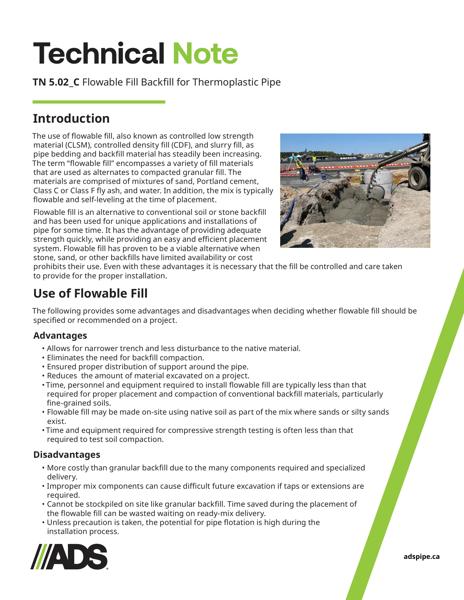
The use of flowable fill, also known as controlled low strength material (CLSM), controlled density fill (CDF), and slurry fill, as pipe bedding and backfill material has steadily been increasing. The term “flowable fill” encompasses a variety of fill materials that are used as alternates to compacted granular fill. The materials are comprised of mixtures of sand, Portland cement, Class C or Class F fly ash, and water. In addition, the mix is typically flowable and self-leveling at the time of placement.
Flowable fill is an alternative to conventional soil or stone backfill and has been used for unique applications and installations of pipe for some time. It has the advantage of providing adequate strength quickly, while providing an easy and efficient placement system. Flowable fill has proven to be a viable alternative when stone, sand, or other backfills have limited availability or cost prohibits their use. Even with these advantages it is necessary that the fill be controlled and care taken to provide for the proper installation.
Advantages of flowable fill include narrow trenches, no backfill compaction, pipe support, less excavated material, less personnel/equipment needed and soils on site can be used.
Disadvantages are more cost, improper mix components can cause difficulty later, can’t be stockpiles and possible pipe flotation during installation.
The mix design of flowable fill can vary widely. The flowable fill mix should be designed to meet all strength and flowability requirements. The flowable fill should be able to flow into all voids between the pipe and the trench walls. The mix design should be laboratory tested prior to installation ensure that the proper results are obtained during field batching. The field mix may also require monitoring and adjustments to maintain the proper mix and properties. These variations in the field mix can be due to many factors including water content, temperature and humidity during placement.
Installation considerations are environment, joints and placement of flowable fill. A table is provided for recommended trench widths for flowable fill backfill and a figure showing hold down force for incremental lifts.
Anchoring systems are explained with a table for hold down force, one continuous lift provided.