
TN 5.11_C Sliplining Extended Lengths with HDPE Pipe
Filename:
TN 5.11_C Sliplining Extended Lengths with HDPE Pipe.pdf
This document is the TN 5.11_C Sliplining Extended Lengths with HDPE Pipe. Overview, preparations and installation provided with figures and descriptors.
HDPE pipe joints are not designed to withstand large pulling forces. Furthermore, pushing a lining pipe in through the host pipe may damage the corrugations at the pipe ends as they butt up against each other. The method of installation will affect, in large part, the maximum length that can be slip lined without damaging the pipe. Using skids, especially in a corrugated host pipe, will help minimize resistance between the two surfaces.
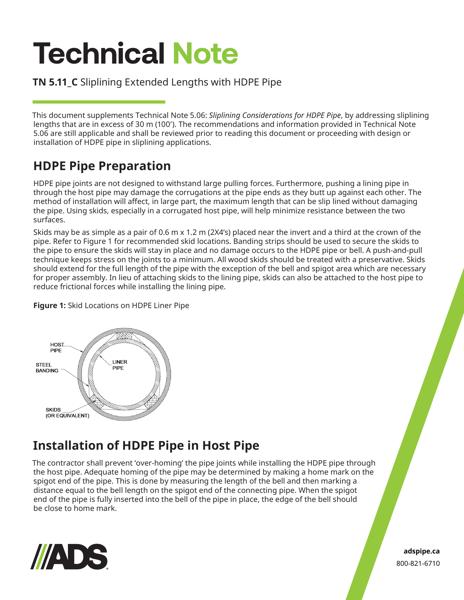
Skids may be as simple as a pair of 0.6 m x 1.2 m (2X4’s) placed near the invert and a third at the crown of the pipe. Banding strips should be used to secure the skids to the pipe to ensure the skids will stay in place and no damage occurs to the HDPE pipe or bell. A push-and-pull technique keeps stress on the joints to a minimum. All wood skids should be treated with a preservative. Skids should extend for the full length of the pipe with the exception of the bell and spigot area which are necessary for proper assembly. In lieu of attaching skids to the lining pipe, skids can also be attached to the host pipe to reduce frictional forces while installing the lining pipe. A figure showing skid locations on HDPE liner pipe provided.
During installation of HDPE pipe in host pipe, the contractor shall prevent ‘over-homing’ the pipe joints while installing the HDPE pipe through the host pipe. Adequate homing of the pipe may be determined by making a home mark on the spigot end of the pipe. This is done by measuring the length of the bell and then marking a distance equal to the bell length on the spigot end of the connecting pipe. When the spigot end of the pipe is fully inserted into the bell of the pipe in place, the edge of the bell should be close to home mark. A figure for inserting sections into host pipe and a detail and figure of the installation of liner pipe using installation stub provided.