
TN 5.22_C Design of Thermoplastic Drainage Structures
Filename:
TN 5.22_C Design of Thermoplastic Drainage Structures.pdf
This document is the TN 5.22_C Design of Thermoplastic Drainage Structures. Overview, background, loading scenarios and performance limits discussed.
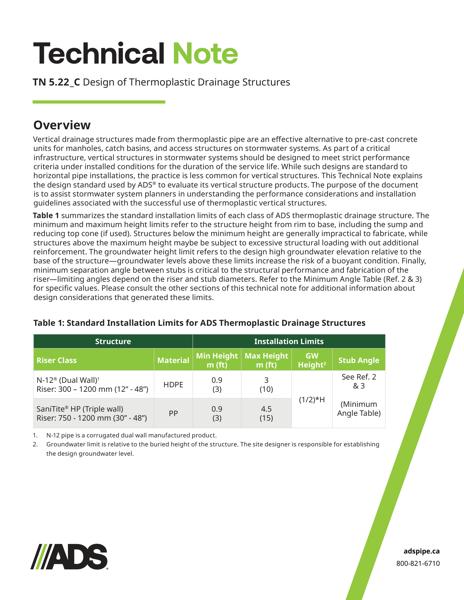
Vertical drainage structures made from thermoplastic pipe are an effective alternative to pre-cast concrete units for manholes, catch basins, and access structures on stormwater systems. As part of a critical infrastructure, vertical structures in stormwater systems should be designed to meet strict performance criteria under installed conditions for the duration of the service life. While such designs are standard to horizontal pipe installations, the practice is less common for vertical structures. Table 1 summarizes the standard installation limits of each class of ADS thermoplastic drainage structure.
ADS fabricates HP Manholes and N-12 catch basins in a range of diameters using our HP (polypropylene) and N-12 (high-density polyethylene) pipe products, respectively. The post-installation performance of the structures are evaluated per the guidance of ASTM F1759 (Ref. 1). Analysis per ATSM 1759 was used in developing the standard performance limits detailed in References 2 & 5, which govern HP Manholes and N-12 catch basins. A figure shows the ADS thermoplastic manhole and standard terminology.
All loads are assumed to be radially symmetric about the center of the riser. And all loads are assumed to vary longitudinally along the axis of the riser. Note, these assumptions are nearly the converse of horizontal pipe analysis, where axial variation is assumption negligible and radial variation is a key part of design. A figure showing the design loads on subsurface vertical structures provided.
Performance limits are explained with supporting table for structural performance limits for subsurface vertical structures. Additional considerations include backfill conditions, groundwater conditions and deep structures.