
TN 5.14_C Culvert Sliplining with HP Pipe
Filename:
TN 5.14_C Culvert Sliplining with HP Pipe.pdf
This document is the 5.14_C Culvert Sliplining with HD Pipe. It explains how the product is the choice to slipline deteriorated pipes with specification information.
It may be at times necessary, in an aging infrastructure, to rehabilitate drainage and sanitary lines by lining them with a new pipe. An abrasive or corrosive environment can cause premature deterioration of some types of pipe. In lieu of a total replacement, sliplining the existing pipe with a durable material may be an economical method to significantly extend the service life. HP Storm pipe made with polypropylene (PP), is often the product of choice to slipline deteriorated pipes because of its resistance to aggressive environments.
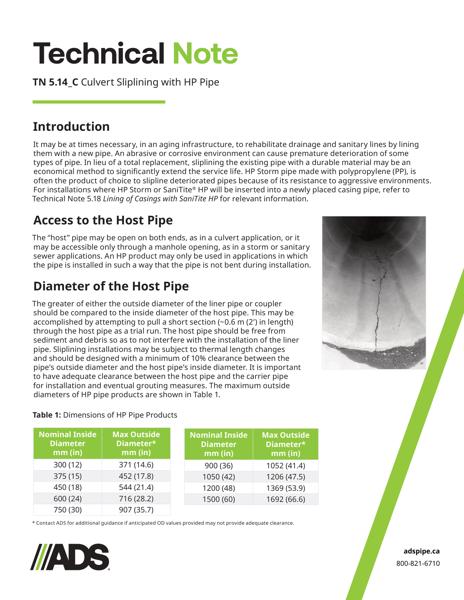
Access to the Host Pipe may be open on both ends, as in a culvert application, or it may be accessible only through a manhole opening, as in a storm or sanitary sewer applications. An HP product may only be used in applications in which the pipe is installed in such a way that the pipe is not bent during installation.
The greater of either the outside diameter of the liner pipe or coupler should be compared to the inside diameter of the host pipe. Sliplining installations may be subject to thermal length changes and should be designed with a minimum of 10% clearance between the pipe’s outside diameter and the host pipe’s inside diameter. A table for HDPE pipe dimensions is shown.
Length of installation and hydraulic considerations are explained.
Structural Requirements discusses failing culverts in need of relining may eventually deteriorate into a conduit with no structural integrity at all. For this reason, it is important to reline with a culvert capable of handling the loads based on its installation assuming no load reduction from the host pipe.
Installation of HDPE in host pipe starts before the HDPE pipe is inserted into an existing culvert for relining, it is critical to inspect the existing culvert for any objects or obstructions, which may be extending into the barrel of the existing culvert to be relined. A figure for attachment of skids to HP pipe provided.
Processes for insertion forces and grouting procedures with photographs is included.